Steel is strong, fast to erect, and cost-effective — but it has a structural weakness under high heat that most building owners don’t fully account for until they’re reviewing a specification. Bare structural steel begins losing significant load-bearing capacity when temperatures exceed 400–550°C. In a building fire, that threshold is reached within 10–20 minutes without fire protection. Fire safety in PEB buildings is the engineering discipline that extends that window — giving occupants time to evacuate and emergency services time to respond.
PEB building fire safety is governed by NBC 2016 and industry standards that specify protection requirements by occupancy type and building height. Steelworks has over 40 years of structural steel fabrication experience including PEB construction for NHPC, BHEL, Delhi Metro, and CPWD — and understands these requirements from design stage through commissioning.
Why Steel Structures Need Fire Protection
Structural steel doesn’t combust — it loses strength. As steel heats, its yield strength drops sharply. At 550°C, steel retains only about 60% of its ambient temperature strength. At 700°C, it’s below 20%. In most industrial or commercial fires, these temperatures are reached within the first 20–30 minutes.
For fire safety in PEB buildings, the design objective is to keep critical structural members below their critical temperature long enough for evacuation and fire suppression. That time is called the required fire resistance rating, and it’s specified in minutes — 30, 60, 90, or 120 minutes depending on the building’s occupancy and risk profile.
Key Fire Safety Requirements for PEB Buildings
The requirements for PEB building fire safety are determined by:
Occupancy type — manufacturing, warehousing, assembly, commercial, and mixed-use buildings each have different risk profiles and corresponding NBC requirements.
Building height and area — taller or larger buildings require higher fire resistance ratings and more comprehensive systems.
Presence of hazardous materials — storage or handling of flammable, explosive, or toxic substances triggers additional fire protection requirements beyond standard NBC provisions.
Insurance requirements — many industrial insurers specify minimum fire resistance ratings for structural members as a coverage condition.
For most single-storey applications, fire safety in PEB buildings requires columns and primary beams to achieve at least R30–R60 fire resistance, with higher ratings for multi-storey structures or buildings near property boundaries.
Fire Protection for Steel Structures
Four main approaches to fire protection for steel structures are used in PEB buildings:
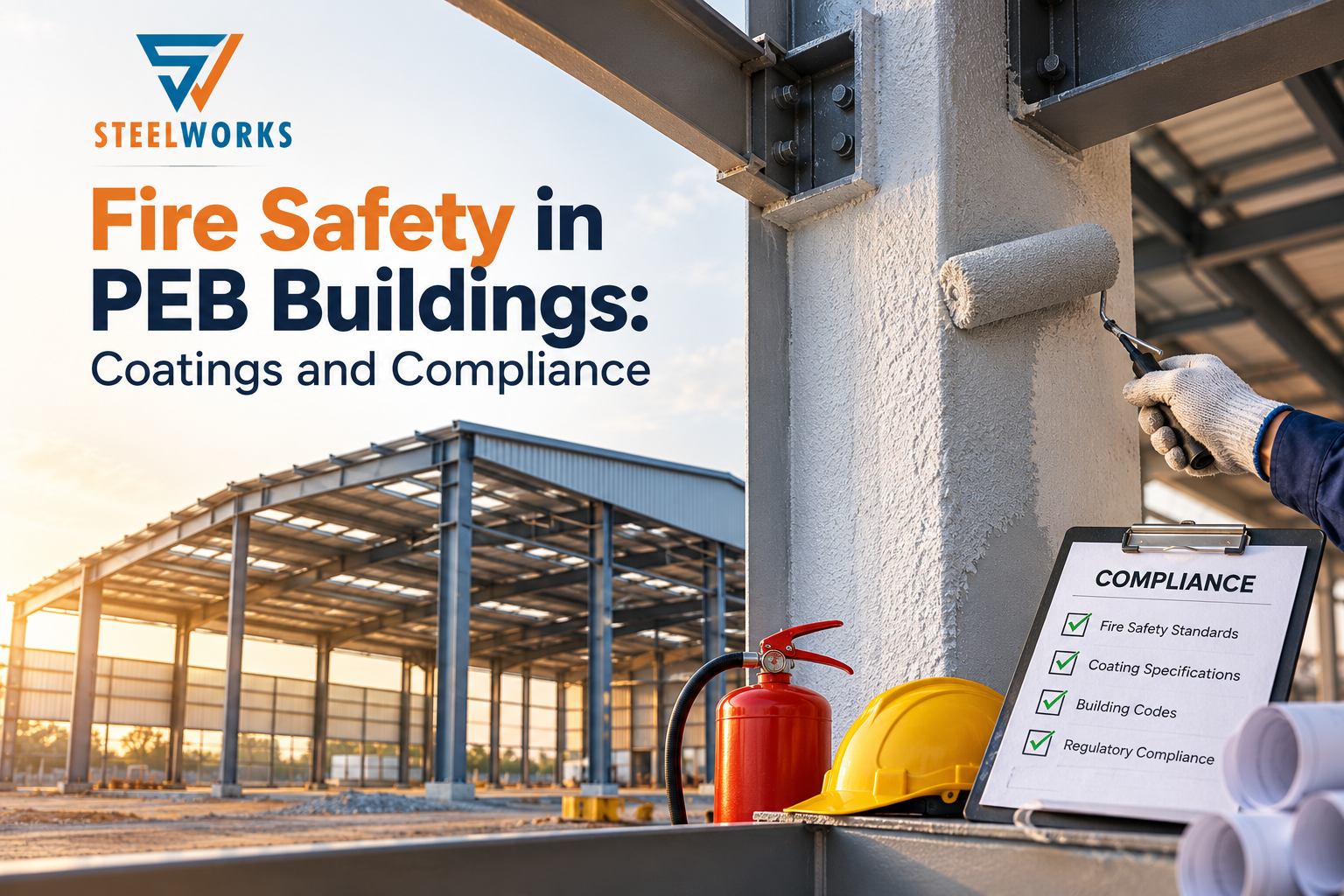
Intumescent coatings — a fire resistant coating for steel that expands dramatically when exposed to heat, forming an insulating char layer that slows temperature rise. This fire resistant coating for steel suits visible structural members where spray or board systems aren’t practical.
Spray-applied fireproofing (SFRM) — cementitious or mineral fibre materials sprayed onto steel surfaces. Economical for concealed steel; thicker application for higher fire resistance ratings.
Board encasement — calcium silicate boards fixed around steel members where a clean finish is required.
Concrete encasement — most fire resistant but heaviest and most expensive; rarely used in PEB buildings.
For most fire safety in PEB buildings applications, intumescent paint and spray-applied fireproofing are the primary choices — selected based on the aesthetic requirements, accessibility during application, and the fire resistance rating required.
Fire-Resistant Coatings for Steel Structures
Intumescent paint (thin-film intumescent coating) is the most widely used fire resistant coating for steel in PEB buildings where structural members are visible or architecturally exposed. Applied in layers to achieve the required dry film thickness, it looks like paint at ambient temperature and provides rated fire resistance when needed.
**Fireproof paint for steel structures is rated to specific fire resistance durations based on the dry film thickness applied and the steel section factor (Hp/A ratio — the ratio of heated perimeter to cross-sectional area). Stocky sections with low Hp/A ratios require thinner coatings for the same rating than slender sections.
Intumescent paint systems must be applied by trained applicators using calibrated equipment. Film thickness must be verified after application — under-application means the fireproof paint for steel structures won’t achieve its rated performance.
Fire resistant paint for external or exposed PEB steel must also be weatherproof. Two-component fire resistant paint systems offer better weathering resistance than water-borne alternatives. Selecting the right fire resistant paint for external exposure is a separate specification from internal applications.
Understanding the Fire Rating of Steel Structures
The fire rating of steel structures is expressed as the time in minutes that a protected element maintains its structural function in a standard fire test. Ratings are designated as R30, R60, R90, R120 — for 30, 60, 90, and 120 minutes respectively.
The fire rating is achieved through the protection system combined with section geometry — heavier sections achieve a given rating with less coating than slender ones.
For fire safety in industrial buildings, the most common fire resistance rating required for primary structural members is R60. Larger warehouses, high-rack storage facilities, and buildings near property lines or occupied structures may require R90.
Fire Safety Systems for Industrial PEB Buildings
Fire safety in PEB buildings extends beyond structural fire protection to include active and passive systems:
Sprinkler systems — the most effective single active measure for controlling fire spread in industrial PEB buildings. Required by NBC 2016 for buildings above specified heights and occupancies. Reduces the fire resistance rating requirement for structural members in many design approaches.
Smoke detection and alarm — required in all occupied PEB buildings; triggers evacuation and alerts emergency services.
Fire extinguishers and hose reels — positioned at specified intervals throughout.
Smoke ventilation — roof-mounted smoke vents or mechanical extraction that limits temperature build-up and aids visibility for evacuation and fire-fighting.
Fire Safety Compliance for PEB Buildings
Fire safety in industrial buildings compliance involves:
NBC 2016 provisions — Part 4 of the National Building Code covers fire protection requirements by occupancy, height, and area. The structural fire resistance requirements are specified here.
Fire NOC — most states require a Fire No Objection Certificate from the local fire authority before occupation of industrial and commercial buildings above specified thresholds.
Third-party inspection — fire protection coatings for structural steel are typically subject to inspection by the project’s structural engineer or a specialist fire engineer to verify application thickness and coverage.
Documentation — product data sheets, application records, and inspection certificates form the compliance documentation that should be retained with the building’s records.
Steelworks designs and fabricates PEB structures with fire safety in PEB buildings considerations integrated from the structural design stage — specifying section sizes and member geometry that achieve required fire ratings with practical protection systems. For enquiries on industrial steel fabrication and PEB projects, contact mail@steelworks.in or visit steelworks.in.
Conclusion
Fire safety in PEB buildings is a structural engineering challenge solved through the right combination of coating systems, passive protection, and active suppression. The fire rating of steel structures is achievable and practical — the key is specifying it correctly at the design stage and applying it correctly during construction.
PEB building fire safety that’s designed in from the start costs significantly less than retrofitting protection after construction. For industrial buildings in India, it pays in both regulatory clearance and actual fire performance.
FAQs
1. Why is fire protection important for steel structures?
Fire protection helps steel structures retain their load-bearing capacity for longer during a fire, allowing more time for evacuation and emergency response.
2. What is intumescent paint for steel structures?
Intumescent paint expands when exposed to heat, forming an insulating char layer that slows the temperature rise in structural steel.
3. What fire rating is required for steel structures in PEB buildings?
The required fire rating depends on occupancy, building height, area, and risk profile, with ratings such as R30, R60, R90, and R120.
4. What are the main methods of fire protection for steel structures?
Common methods include intumescent coatings, spray-applied fireproofing, board encasement, and concrete encasement.
5. How can PEB buildings meet fire safety compliance requirements?
PEB buildings must follow applicable NBC 2016 provisions and may require a Fire NOC, coating inspections, and proper fire protection documentation.