
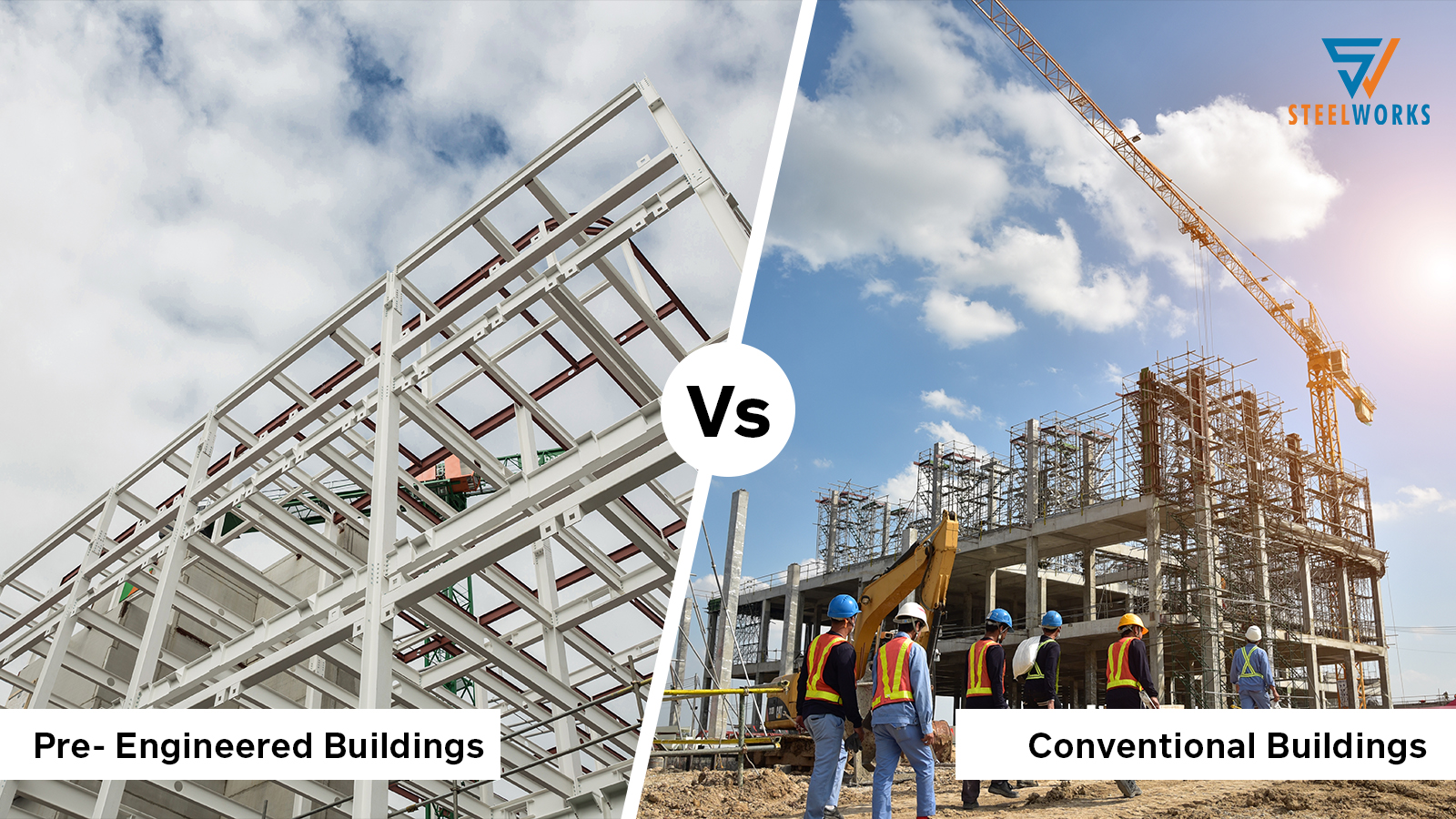
Choosing the Right Building Method for Your Project
You need a warehouse, factory, showroom, or office space, and are stuck on whether to go for “PEB or conventional?”. What’s the actual difference? Which costs more? Which gets completed faster? The debate of pre-engineered buildings vs conventional buildings isn’t new, but it’s more relevant than ever as construction timelines shrink and budgets tighten.
At Steelworks, we’ve built hundreds of structures, and here’s what we’ve learned – the “right” choice depends entirely on your specific project. But understanding the difference between PEB and conventional building helps you make that choice intelligently, not just based on what someone else did or what sounds familiar.
What Are Pre-Engineered Buildings (PEB)?
Pre-engineered buildings are structures where the steel components are designed, fabricated, and assembled in a factory, then transported to the site for quick assembly. Think of it like buying furniture from IKEA – pieces come ready-made, you just assemble them on-site.
PEB uses lightweight steel frames engineered specifically for your building’s dimensions and load requirements. Roof, walls, and structural components arrive at the site ready to bolt together. The entire structure is designed using advanced software that optimizes material usage, ensuring you’re not paying for excess steel you don’t need.
What Are Conventional Buildings?
Conventional buildings use traditional construction methods – brick, concrete, heavy steel beams built entirely on-site from scratch. Think of buildings you see everywhere – concrete columns, brick walls, RCC roof.
In this setup, everything happens at the construction site. Workers mix concrete, lay bricks, tie reinforcement steel, pour concrete, and wait for it to cure. Its construction is the way it’s been done for decades.
Conventional methods work wonderfully for certain applications, particularly multi-story structures, residential buildings, or projects where specific architectural finishes are priorities.
Difference Between PEB and Conventional Building
Let’s break down how pre-engineered buildings vs conventional buildings actually compare:
| Aspect | Pre-Engineered Buildings (PEB) | Conventional Buildings |
| Construction Time | Typically takes 3-4 months | Typically takes 8-12 months |
| Design Flexibility | Varied steel frame designs that are easily replaceable | Varied design options, but they are hard to replace as they require manual labor for alteration |
| Initial Cost | Generally, 20-30% lower | Higher initial investment |
| Foundation Requirements | Lighter foundation needed | Heavy foundation required |
| Material Waste | Minimal, as it is set up in the factory | Significant on-site waste |
| Weather Dependency | Less affected (mostly at the time of assembly) | Heavily weather-dependent |
| Future Expansion | Easy to expand | Difficult and expensive |
| Maintenance | Minimal (factory precision) | Significant on-site waste |
| Skilled Labor | Less skilled labor for assembly | Heavily weather-dependent |
| Quality Control | Factory-controlled consistency | Depends on site supervision |
| Interior Span | Large column-free spaces are possible | Limited by structural needs |
| Energy Efficiency | Excellent with proper insulation | Varies based on design |
Pre-Engineered Buildings vs Conventional Buildings Cost
Let’s discuss pre-engineered buildings vs conventional buildings’ cost. PEB typically costs 20-30% less than conventional construction for a similar covered area. Why? Factory fabrication is more efficient than on-site construction. Less material waste. Faster completion means lower labor costs. Lighter structures need simpler foundations, saving significantly.
But the total cost isn’t just about construction. PEB buildings often have lower operational costs through better energy efficiency and reduced maintenance. The initial savings plus operational benefits make PEB significantly more economical over the building’s lifetime.
Benefits of Using PEB Over Conventional Buildings
Why are pre-engineered buildings vs conventional buildings increasingly favoring PEB for industrial and commercial applications?
Speed – Time is money in business. PEB gets completed 50-60% faster than conventional construction. Your business starts operating sooner, generating revenue months earlier.
Cost Efficiency – Lower construction costs, reduced foundation expenses, minimal waste, and faster completion all contribute to significant savings.
Quality Consistency – Factory fabrication with precision machinery ensures consistent quality that on-site construction struggles to match.
Flexibility – Need to expand later? PEB buildings extend easily without major structural modifications.
Large Spans – PEB creates column-free spaces up to 90 meters, impossible with conventional construction economically.
Durability – Quality steel structures with proper coatings last 40-50 years with minimal maintenance.
Energy Efficiency – Properly insulated PEB buildings reduce cooling and heating costs substantially.
How to Choose Between PEB and Conventional?
The difference between PEB and conventional building means each suits different applications. Choose based on:
Building Purpose – Warehouses, factories, showrooms, aircraft hangars? PEB excels. Residential apartments, hotels, hospitals? Conventional building is better.
Budget Constraints – Tighter budget favors PEB’s lower costs. If budget isn’t the primary concern and aesthetics matter more, conventional offers more options.
Timeline – Need to start operations quickly? PEB’s faster construction timeline is invaluable.
Future Plans – Planning potential expansion? PEB’s expansion outstands conventional method.
Location – Remote locations where transporting mixed concrete is difficult favor PEB. Urban areas with easy material access suit conventional construction.
Architectural Requirements – Specific aesthetic finishes or complex designs might need conventional methods.
Why Choose Steelworks for Your PEB Project?
When you’re deciding on pre-engineered buildings vs conventional buildings and PEB makes sense, then choosing the right PEB manufacturer matters significantly. Here’s why Steelworks stands out as the best PEB manufacturer in India:
Engineering Expertise – We don’t just manufacture steel structures; we engineer solutions. Our team designs PEB buildings optimized for your specific requirements, not generic templates.
Quality Manufacturing – Our fabrication facilities use advanced machinery, ensuring precision and consistency. Every component gets inspected before leaving our factory.
Complete Solutions – From initial design to final installation, Steelworks handles everything. Single-vendor accountability means no finger-pointing when challenges arise.
Proven Track Record – Hundreds of successful PEB projects across industries. Our buildings perform reliably because we understand the difference between PEB and conventional building requirements thoroughly.
Timely Delivery – We commit to timelines and deliver. Your project schedule matters to us as much as it matters to you.
Cost Transparency – No hidden charges or surprise costs. What we quote is what you pay for your pre-engineered buildings.
Conclusion
The pre-engineered buildings vs conventional buildings debate doesn’t have a universal answer. Both methods work beautifully for appropriate applications. Conventional construction offers design flexibility and familiarity. PEB provides speed, cost efficiency, and flexibility.
Understanding the difference between PEB and conventional building helps you evaluate which aligns with your project’s priorities – timeline, budget, functionality, and plans. Ready to discuss your project? Contact Steelworks today for expert guidance on pre-engineered buildings.
Disclaimer:
This blog is intended for informational purposes only. It does not constitute professional advice or a formal recommendation. For detailed information, personalized guidance, and to learn more about our services, please contact Steelworks directly.
Read Also : Types of Insulation in PEB Structure