
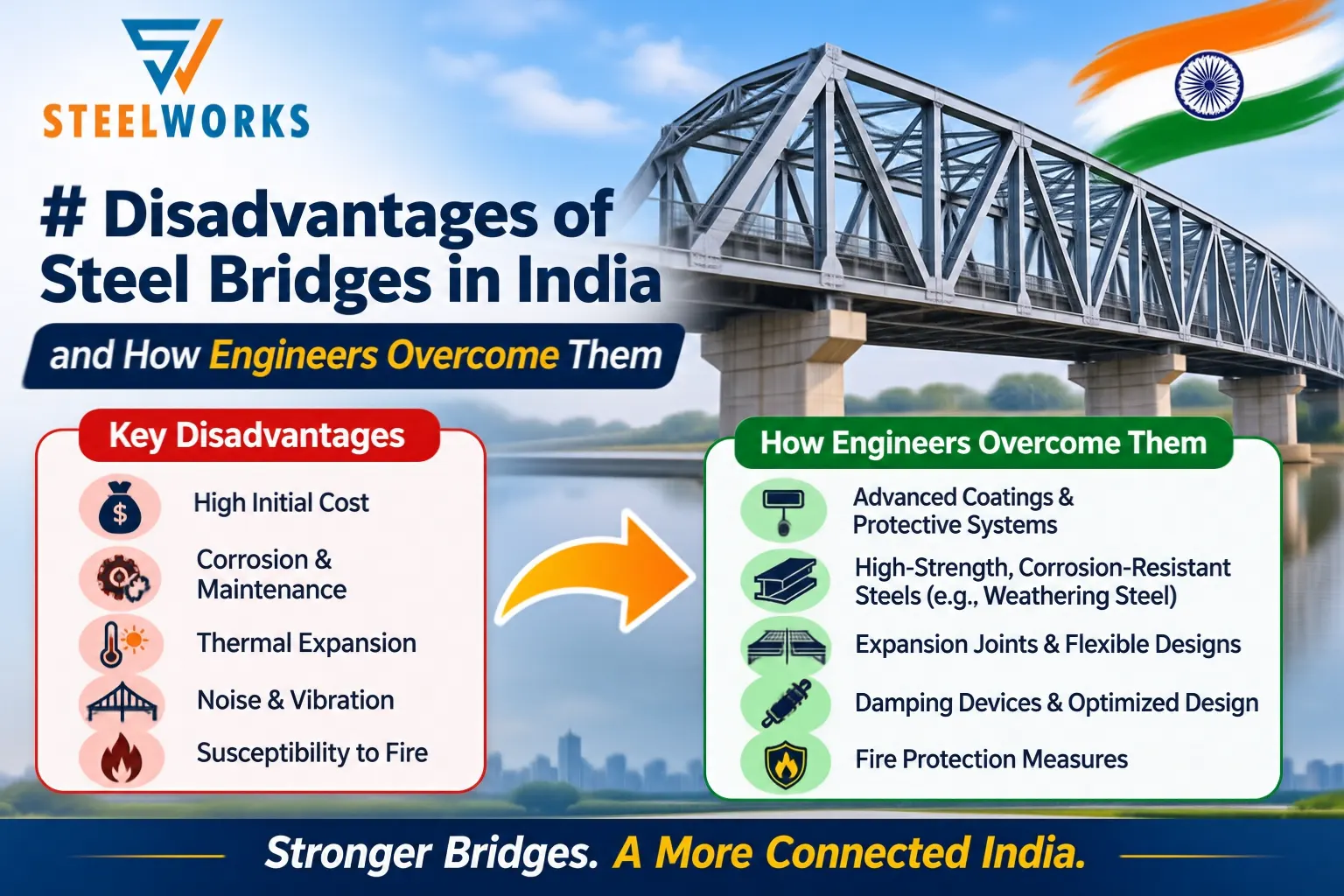
India’s coastline jumped to 11,098.81 km in December 2025, up from 7,516.6 km. All that extra water hides a quiet appetite for iron, because the disadvantages of steel bridges show up fastest where salt air, monsoon damp, and heavy freight meet. Constant coastal and humid climate exposure feeds rust fast.
This piece looks at the advantages and disadvantages of steel bridges in India from the weakness side, focusing on where the metal struggles on site. Every weakness below comes with a practical fix backed by Indian codes.
Advantages and Disadvantages of Steel Bridges in India
Indian sites punish metal. Salt winds blow off an 11,098.81 km coast while freight trains run 25 t axle loading on identified routes and 32.5 t on the DFC. Those twin forces test every joint.
| Strength | Matching weakness | Indian trigger |
|---|---|---|
| High strength for low weight | Thin sections lose capacity fast once rust starts | Salt air along an 11,098.81 km coast |
| Fast shop fabrication | Quality rests on welds and fit-up | Remote hill and North-East sites |
| Long, slender spans | Fatigue at welded and riveted details | 25 t and 32.5 t axle loads on old girders |
| Continuous steel members | Large thermal expansion movement | Wide seasonal temperature swings |
| Easy to repair and strengthen | Needs inspection and repainting | Repeated monsoon wet-dry cycles |
| Recyclable | Higher first cost than RCC on short spans | L1 tendering on first cost |
Every item in the middle column can be managed by detailing it at the drawing stage and planning steel bridge maintenance from day one.
7 Key Disadvantages of Steel Bridges
Each item below follows the same pattern: the engineering problem, Indian evidence, then the fix.
1. Corrosion in Coastal Zones
When weighing the advantages and disadvantages of steel bridges in India, corrosion in steel bridges is the first threat. Rust closed the 1914 Pamban bridge to rail traffic in December 2022. On the Howrah Bridge, gutkha spit cut the steel hanger hoods to about half their original thickness in four years, says the KoPT chief engineer. That is human-caused corrosion that no design code plans for. At Morbi, the SIT found 22 of the 49 wires in one main cable corroded.
How Engineers Fix It
Engineers apply protective coating systems in layers. The New Pamban Bridge uses zinc metallizing, a zinc-rich primer, and a polysiloxane topcoat rated for at least 35 years, with the girder underside raised 3 m above the splash zone. Southern Railway estimates 38 years of life with no maintenance and 58 years with minimal upkeep. Physical guards help too: Howrah now has 86 fibreglass hoods at the hanger bases.
Weathering steel is made to IS 11587, and Tata Steel received the first BIS licence for it. Still, US FHWA T 5140.22 guidance warns engineers to use it with caution in marine coastal areas, high humidity or fog, and near industrial fumes. So it is not a blanket fix for coastal India.
2. Fatigue Cracking on Old Girders
Metal gets tired. Fatigue cracking comes from millions of stress cycles. The Railway Board (04.06.2024) notes that most old bridges were designed without enough fatigue protection. Its records list 2,752 steel bridges older than 50 years, and routes above 40 GMT get priority for residual fatigue checks (13.06.2024).
How Engineers Fix It
- A first screen using the IRS Steel Bridge Code (Annexure G).
- A residual fatigue life check under RDSO BS-91.
- Strain instrumentation under BS-106 R2.
- PAUT checks on welds, as used on New Pamban.
- Replacing loose rivets with HSFG bolts.
On older routes, fatigue checks are now a normal part of steel bridge maintenance.
3. Thermal Expansion
Heat stretches metal. Steel expands by 12 × 10⁻⁶ per °C (IS 800). Unchecked thermal expansion is one of the disadvantages of steel bridges that stays invisible until joints jam or bearings creep out of position. Formula: change in length = span × 0.000012 × temperature change.
The worked figures below cover a 40 °C swing; the design value comes from the loading code temperature range.
| Span (m) | Example span | Movement (mm) |
|---|---|---|
| 30 | Typical FOB | 14.4 |
| 53 | NH 301 girder | 25.4 |
| 62 | Gelephu arch girder | 29.8 |
| 100 | Teesta VI OWG | 48.0 |
How Engineers Fix It
Use one fixed and one free bearing per span. Size the joint gap from the code temperature range and preset bearings for the installation day temperature.
4. Bearing and Expansion Joint Wear
Supports take the beating. Bearing and expansion joint wear is where steel bridge maintenance budgets quietly drain. MoRTH directs inspections of bearings and joints during extreme seasons and after floods. A 2023 Railway Board inspection drive (25.07.2023) also singled out bearing condition and seating.
How Engineers Fix It
Follow RDSO BS-102 (Rev 1, June 2015) for installing, inspecting, and maintaining bearings. Design in jacking points so bearings can be replaced, and clear debris from joints before every monsoon.
5. High Lifecycle Cost
Cheap bids hide steep upkeep. Lifecycle maintenance cost, not the first price, is where the disadvantages of steel bridges show up in money. On Howrah, KoPT spent ₹2.57 crore on upkeep in FY13, then ₹15 lakh more for hoods.
How Engineers Fix It
Compare whole-life cost at tender stage. Match the coating to site exposure and build in inspection walkways so that inspecting the bridge costs less.
6. Fire Exposure
Steel loses strength when very hot. Vehicle fires and material stored under flyovers and ROBs make heat one of the less-discussed disadvantages of steel bridges. IS 800 has a dedicated fire-resistance section, Section 16.
How Engineers Fix It
Use intumescent coatings, design for fire resistance under IS 800 Section 16, and keep space under the deck clear. Read more in our Steelworks blog on fire safety in PEB buildings.
7. Weld Quality and Skilled Labour
Bad welds ruin good steel. The last of the disadvantages of steel bridges is that the bridge is only as good as its welds. The Morbi SIT flagged old suspenders welded to new ones, and the Railway Board (16.09.2022) repeated that IRBM para 617 limits welding pathways onto existing girders.
How Engineers Fix It
- Use RDSO-approved fabricators working to a QAP and WPS.
- Have RDSO inspect components before dispatch (RDSO BS-125).
- Trial-assemble the girder in the shop.
- Run UT and PAUT checks on the welds.
Steel Bridge Maintenance Plan
A written plan costs less than an emergency repair.
Periodic Bridge Inspection
Set periodic bridge inspection to the calendar and the weather, not just to the age of the bridge.
| What | When | Basis |
|---|---|---|
| All NH bridges | Once a year | MoRTH |
| Bridges in hilly terrain | Before and after the monsoon | MoRTH (same) |
| Bearings and joints | Extreme seasons and after floods | MoRTH |
| Rail OWG and underslung girders | Senior officer assigned to each bridge (“Own Your Bridge”) | Railway Board, 2023 |
| Hard-to-reach spans | Drone plus 3D BrIM inspection | RDSO BS-129 (R1), May 2021 |
Coating Renewal
Use patch painting with anti-corrosive paint to hold off rust until the next full painting cycle (Railway Board, 26.04.2024). Do a full repaint when breakdown is widespread, logging the DFT each time on protective coating systems.
Health Monitoring
Fit strain and deflection instruments to heavy-haul spans under BS-106 R2.
Why Steelworks
Steelworks is the one true companion for every steel-related problem, backed by 40+ years in the business, RDSO vendor approval for two group companies, and ISO certificates. A buyer weighing the advantages and disadvantages of steel bridges in India needs a partner who designs the fixes from the start.
Our services cover:
- Steel bridges: NH bridges, railway bridges and camelback girders, FOBs and skywalks, ramps and cable-stayed structures.
- PEBs and customised fabrication.
- Tunnel formworks: tunnel lining, plus cut-and-cover.
- Heavy fabrication, such as the BHEL elbow duct.
- The full cycle: design, fabrication, surface protection, then erection and commissioning.
Key projects include:
- Mahalaxmi cable-stayed ROB: 165 m, trial assembly at the Alwar unit, checked by RITES and BMC.
- Surat Metro: 86 m OWG.
- NH 301 Kargil-Zanskar: 53 m girder for NHIDCL.
- Gelephu, Bhutan: 62 m arch string girder.
- NHPC Teesta VI: 100 m OWG, in progress.
- Delhi-Amritsar-Katra Expressway: 4 × 47.4 m spans at a 47° skew.
Send drawings with span, loading, and location.
Conclusion
Each of the disadvantages of steel bridges in this article is known, measurable, and solved by engineering: corrosion, fatigue, movement, wear, cost, fire, and workmanship.
Contact Steelworks with your drawings to get started.
Acronyms Used
| Acronym | Full form |
|---|---|
| BHEL | Bharat Heavy Electricals Limited |
| BIS | Bureau of Indian Standards |
| BMC | Brihanmumbai Municipal Corporation |
| BrIM | Bridge Information Modelling |
| BS | Bridges and Structures (RDSO report series) |
| DFC | Dedicated Freight Corridor |
| DFT | Dry Film Thickness |
| FHWA | Federal Highway Administration (United States) |
| FOB | Foot Over Bridge |
| FY | Financial Year |
| GMT | Gross Million Tonnes (yearly traffic on a rail route) |
| HSFG | High Strength Friction Grip |
| IRBM | Indian Railways Bridge Manual |
| IRS | Indian Railway Standard |
| IS | Indian Standard |
| ISO | International Organization for Standardization |
| KoPT | Kolkata Port Trust |
| L1 | Lowest bidder in a tender |
| MoRTH | Ministry of Road Transport and Highways |
| NH | National Highway |
| NHIDCL | National Highways and Infrastructure Development Corporation Limited |
| NHPC | NHPC Limited (formerly National Hydroelectric Power Corporation) |
| OWG | Open Web Girder |
| PAUT | Phased Array Ultrasonic Testing |
| PEB | Pre-Engineered Building |
| QAP | Quality Assurance Plan |
| RCC | Reinforced Cement Concrete |
| RDSO | Research Designs and Standards Organisation |
| RITES | RITES Limited (formerly Rail India Technical and Economic Service) |
| ROB | Road Over Bridge |
| SIT | Special Investigation Team |
| UT | Ultrasonic Testing |
| WPS | Welding Procedure Specification |
FAQs
What are the advantages and disadvantages of steel bridges in India?
The main advantages and disadvantages of steel bridges in India are strength, speed, and long spans on one side, and corrosion, fatigue, fire risk, and higher first cost on the other.
What does steel bridge maintenance involve?
Steel bridge maintenance means yearly inspection, extra checks around the monsoon, bearing and joint checks after floods, and patch painting between full repaints.
Is metal fatigue checked during steel bridge maintenance?
Yes. On old rail girders, fatigue checks under the IRS Steel Bridge Code and RDSO BS-91 are now routine steel bridge maintenance.
Why not use stainless steel to cut steel bridge maintenance?
Stainless steel costs about four times as much as carbon steel. Layered coatings and zinc metallizing cut steel bridge maintenance for far less.
How do the advantages and disadvantages of steel bridges in India compare with those of concrete?
Steel wins on long spans, speed, and repairs, while RCC is often cheaper on short spans. Judge the advantages and disadvantages of steel bridges in India on whole-life cost.