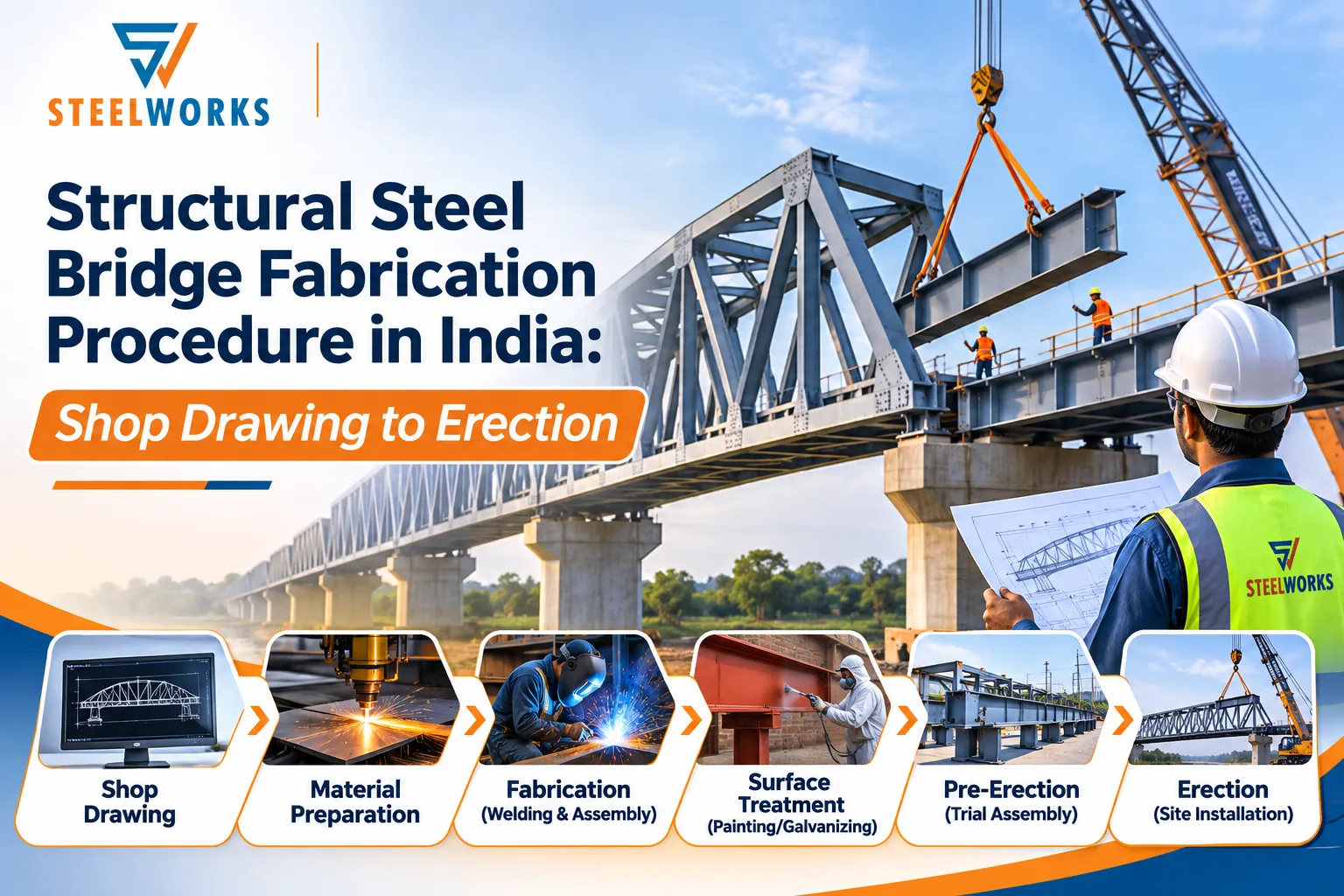
The structural steel bridge fabrication procedure in India is one long chain, running from approved drawings to a girder resting on its bearings. Most site troubles, like a hole group 1 mm out or camber read on a sun-warmed girder, are born in the shop.
Here’s the quiet rule. Every stage below ends at a hold point. A steel bridge that skips one keeps the fault and carries it to the site, where fixes happen at height.
Structural Steel Bridge Fabrication Procedure in 10 Stages
Ten stages, ten gates, and each one stays shut until its check is signed.
| Stage | Hold point before the next |
|---|---|
| 1. Shop drawings | QAP approved |
| 2. Template layout | Camber layout checked |
| 3. Material | Steel cleared |
| 4. Cutting | Edge hardness checked |
| 5. Drilling | Hole size and position |
| 6. Welding | Qualified WPS |
| 7. NDT | Welds accepted |
| 8. Trial assembly | Within tolerance |
| 9. Surface protection | Coating thickness |
| 10. Erection | Bolt checks |
Codes for Structural Steel Bridge Fabrication
Railway Girders
Railway work answers to IRS B1-2001 and the IRS Welded Bridge Code. RDSO’s BS-110 (R), revised in March 2016, adds checklists for before, during, and after fabrication.
Road Bridges
Road bridges follow IRC 24, with IRC:SP:104-2015 covering fabrication and erection. Most numbers below come straight from it.
Shop Drawings Approval
Nothing gets cut on a hunch. The shop works only from drawings the Engineer has approved (IRC:SP:104, cl. 1.1), and no work starts until the QAP is approved (cl. 1.5). Shop drawings approval is where the structural steel bridge fabrication procedure earns its calm.
Full-Scale Camber Layout
Camber is drawn full size on a leveled bed, and jigs are made from it (cl. 1.7). Railway work uses a calibrated steel tape (BS-110). Now the hidden detail. Camber is measured only after welding and cooling are complete (cl. 1.16.20). A warm girder fibs.
Material Test Certificates
Steel shows up with paperwork. Every section needs material test certificates, and test pieces from each cast go to an independent test house. Plates enter a steel bridge only when the MTC and that report agree (IRC:SP:104, cl. 1.3).
Grade and Quality
Railway girders use IS 2062 E250, quality B0, where service temperature stays at or above 0°C. Sub-zero areas get quality C, with toughness proven at -20°C. Plates under 12 mm skip normalizing (IRS B1, A&C slip No. 05).
Plates Tested First
UT is mandatory for plates 25 mm and thicker (cl. 1.16.2).
Cutting and Edge Preparation
A flame cut looks clean. It isn’t. The heat hardens the edge, and fatigue cracks love to start in that band. So cutting and edge preparation get their own gate in structural steel bridge fabrication.
Flame-Cut Edges
Hardness is capped at 350 BHN, and at least 2 mm comes off (cl. 1.9.1).
Holes and Drilling
Per cl. 1.11:
| Case | Rule |
|---|---|
| Fastener up to 25 mm | Hole 1.5 mm larger |
| Fastener above 25 mm | Hole 2.0 mm larger |
| E250 over 20 mm, E350 over 16 mm | Drill 3 mm under, ream after assembly |
Welding to an Approved WPS
A WPS is a recipe cooked once before anyone trusts it. The shop proves it on a test joint, and then production stays within those settings. That’s the least glamorous step in the structural steel bridge fabrication procedure in India.
Procedure and Welders
Procedures qualify to IS 7307 (Part 1); welders to IS 7310 (Part 1). Railway electrodes come from the RDSO list under IRS M-28.
Parameter Limits
Current ±10%, arc voltage ±7%, travel speed ±15% (cl. 1.15.10). Past that, stop.
Preheat by Thickness
Low-hydrogen or SAW on mild and medium tensile steel (Table 2):
| Thickest part | Minimum preheat |
|---|---|
| Up to 19 mm | None |
| 19-38 mm | 10°C |
| 38-64 mm | 66°C |
| Over 64 mm | 107°C |
Ultrasonic Testing and NDT
Every weld gets a visual check, no exceptions. MPI and DPT catch cracks sitting on the surface. UT and RT hunt the buried ones, the kind that hide inside a steel bridge until traffic finds them.
Which Welds Get Tested
The amount of testing follows the stress (cl. 1.16.16):
| Butt weld location | NDT extent |
|---|---|
| Tension flange, transverse | 100% |
| Tension flange, longitudinal | 10% of the length |
| Compression flange | 5% of length |
Trial Assembly and Match Marking
Before anything ships, the neighbors meet. In trial assembly, modules are matched to the pieces beside them (IRC:SP:104, cl. 1.4), and railway work gets one complete span checked by RDSO (BS-110). It’s the last calm spot in the structural steel bridge fabrication procedure to catch a mismatch.
Tolerances That Matter
Appendix B sets the limits:
| Check | Tolerance |
|---|---|
| Overall girder length | +6 / -3 mm |
| Bearing centers | ±1 mm |
| End diagonals | ±3 mm |
| Holes within a group | ±0.5 mm |
Marking for Site
For match marking, each part carries a mark and serial number, stacked with marks visible (cl. 2.2.1).
Shot Blasting and Metallizing
No coating touches steel until fabrication is cleared. Then a clock starts. Shot blasting leaves a clean, rough surface that begins to rust within hours, so the spray follows fast. This part of structural steel bridge fabrication determines how long before anyone climbs up with a brush.
Metallizing Figures
Blast to Sa 2½ (cl. 1.18.2). Spray within 8 hours. Lay at least 2 passes for a nominal 150 µm, with no spot under 110 µm (Appendix E).
Zinc or Aluminum
Indian bridge specifications are written around sprayed aluminum. Zinc metallizing comes in when the contract names it, and its sacrificial action suits rail bridges exposed to collision damage.
Launching and Erection
The site picks the method. Never the reverse. Temporary works get checked before the first lift, because the structural steel bridge fabrication procedure either finishes cleanly or stumbles at launching and erection.
Choosing the Method
- Crane lift: short, reachable spans.
- Launching with a nose: over live roads, rail lines, or valleys.
- Cantilever: long trusses with no ground support.
- Float-in: rivers.
Site Checks
In multi-crane lifts, no crane reaches 75% of net capacity (Appendix K). Torque-check 10% of HSFG bolts per connection, minimum two (cl. 1.16.7).
SteelWorks: Your Steel Bridge Partner
SteelWorks is the one-call for steel structure problems. Highway, railway, and foot over bridges, skywalks, ramps, and cable-stayed structures. PEBs and customized fabrication. Tunnel lining formwork, with 40+ years behind it. Design, surface protection, erection, and commissioning sit under one roof.
The paperwork backs it up. RDSO vendor registration (ID 1050644) covers 10,000 MT a year, and the Alwar works has its own template, blasting and metallizing shops, with ISO 9001 from BIS. Its structural steel bridge fabrication record includes an 86 m OWG for Surat Metro and a 62 m OWG trial assembly for an ROB on the Howrah-Mumbai line.
Conclusion
So that’s the structural steel bridge fabrication procedure in India in one pass: approved drawings, a camber read cold, certified steel, a WPS held to its limits, NDT matched to stress, a checked trial assembly and 150 µm of metal spray.
When your next span is ready for the shop, send the drawings to SteelWorks.
Acronyms Used
| Acronym | Full form |
|---|---|
| A&C | Addendum and Corrigendum |
| BHN | Brinell Hardness Number |
| BIS | Bureau of Indian Standards |
| DPT | Dye Penetrant Testing |
| HSFG | High Strength Friction Grip |
| IRC | Indian Roads Congress |
| IRS | Indian Railway Standard |
| IS | Indian Standard |
| ISO | International Organization for Standardization |
| MPI | Magnetic Particle Inspection |
| MT | Metric Tonne |
| MTC | Material Test Certificate |
| NDT | Non-Destructive Testing |
| OWG | Open Web Girder |
| PEB | Pre-Engineered Building |
| QAP | Quality Assurance Plan |
| RDSO | Research Designs and Standards Organisation |
| ROB | Road Over Bridge |
| RT | Radiographic Testing |
| SAW | Submerged Arc Welding |
| SP | Special Publication |
| UT | Ultrasonic Testing |
| WPS | Welding Procedure Specification |
FAQs
1. What is structural steel bridge fabrication?
It is the shop work that cuts, welds, tests, and coats the girders of a steel bridge before they reach the site.
2. What are the steps of steel bridge fabrication?
Structural steel bridge fabrication runs from drawings and camber layout to material checks, cutting, welding, NDT, trial assembly, metallizing, and erection.
3. Do steel bridge fabricators make their own steel?
No. Mills supply certified plates, and structural steel bridge fabrication starts once that steel clears its MTC and lab tests.
4. Which steel suits structural steel bridge fabrication in India?
Railway girders use IS 2062 E250 (quality B0 above 0°C, quality C in sub-zero areas); a road steel bridge uses the grade its design names.
5. How is a steel bridge protected from rust?
During structural steel bridge fabrication, members are shot-blasted to Sa 2½, metallized with 150 µm of sprayed aluminium, then painted.