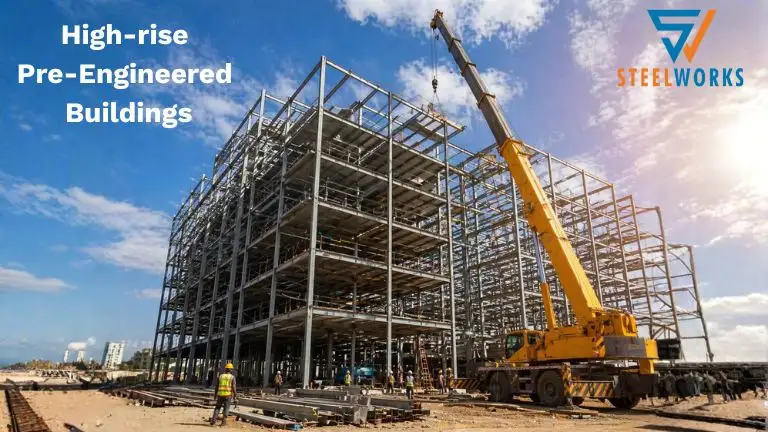
When you visualize pre-engineered buildings, you are likely to imagine single-story warehouses or industrial sheds. However, this is now changing, high-rise pre-engineered buildings are coming into reality in India, and addressing issues that traditional construction is unable to keep pace with.
Think of constructing a multi-story complex in half the time. That is what the modern high-rise PEB building manufacturers in India are providing. PEB technology is rising to the occasion as cities are rising higher and schedules are becoming shorter.
We should discuss what high-rise PEBs are, why they are becoming popular, and whether they are a good fit in your project.
What is a High-Rise PEB Building?
A high-rise PEB building is a multi-story building in which the members are pre-engineered, factory-manufactured, and assembled on-site. Whereas conventional PEBs are limited to one or two stories, high-rise versions extend to several stories.
The whole building is designed by engineers with the help of sophisticated software that calculates loads, stresses, and structural requirements. The steel elements, columns, beams, purlins, panels, are manufactured with accuracy in regulated factories. These components come in ready to assemble.
The high-rise component is a result of improved engineering. Single-story spans are made with lighter frames in standard PEBs. High-rise pre-engineered buildings are constructed with stronger steel sections, reinforced connections, and special design to support vertical loads and lateral forces.
The majority of high-rise PEB buildings in India are between 3 and 8 stories. They are offices complexes, apartments, commercial centers, and mixed-use developments where the speed of construction is important.
Why Choose a High-Rise PEB Building Manufacturer in India?
If you can build conventionally, why go with a high-rise PEB building manufacturer? Here’s what changes.
Speed Traditional high rise building construction takes 18-24 months for a 5-story structure. High-rise PEB building manufacturers in India cut that by 40-50%. Factory fabrication happens simultaneously with site prep. Once foundations are ready, buildings go up fast.
For commercial projects, every month of delay costs rental income. Faster completion means quicker sales and better cash flow.
Quality Control Building quality depends on site conditions conventionally. Rain, heat, worker skill—all vary. A high-rise PEB building manufacturer produces components in controlled factories where every weld, bolt hole, and panel gets inspected. That consistency is better than open construction sites.
Design Flexibility Modern high-rise pre-engineered buildings aren’t cookie-cutter boxes. Customize layouts, add architectural features, incorporate glass facades. The structural system handles varied designs while maintaining PEB advantages.
Key Features of High-Rise PEB Buildings
Advanced Engineering – Sophisticated software optimizes every structural element. Load calculations, wind analysis, seismic considerations handled before cutting steel.
High-Strength Steel – Heavier gauge steel and reinforced sections handle multi-story loads. Columns designed for cumulative weight.
Rigid Frame Systems – Moment-resisting frames provide stability without constant shear walls. More usable interior space.
Integrated Floors – Composite slabs and multi-level platforms part of the engineered system from the start.
Seismic Resistance – Structures meet IS codes for seismic safety with ductile detailing and proper load paths.
Applications of High-Rise PEB Buildings
Commercial & Office – Multi-story office complexes, IT parks, corporate headquarters adopt high-rise PEBs.
Residential – Mid-rise apartment buildings. Speed helps complete projects before market changes.
Mixed-Use – Ground floor retail with offices above. Layouts vary floor by floor.
Hotels – Quick opening for revenue. Column-free spans create flexible rooms.
Educational – Multi-story schools, colleges. Clear spans work for varied needs.
Healthcare – Hospitals benefit from PEB speed and ability to create specialized spaces.
Main Components Used in High-Rise PEB Construction
Primary Steel Frame – Heavy-duty columns and beams. Hot-rolled or built-up sections for vertical loads.
Secondary Framing – Purlins, girts, eave struts support wall/roof panels.
Floor Systems – Composite slabs, metal decking with concrete.
Bracing – Diagonal or cross bracing for lateral stability against wind and seismic forces.
Wall Panels – Insulated metal or curtain wall systems. Weather protection, insulation, aesthetics.
Connections – High-strength bolts, welded connections. Connection design determines strength.
Design & Safety Considerations for High-Rise PEB Buildings in India
Load Analysis – Every floor adds weight. A high-rise PEB building manufacturer must account for cumulative vertical loads increasing at bottom floors.
Seismic Design – India has multiple seismic zones. Buildings need ductile detailing and proper load paths. Following IS 1893 and IS 800 is mandatory.
Fire Safety – Multi-story buildings have stricter regulations. Fire-resistant coatings, fireproof partitions, escape routes, sprinklers are critical.
Material Quality – Certified steel meeting IS standards ensures integrity. Substandard material is dangerous in multi-story construction.
Professional Engineering – Multi-story PEB design needs experienced structural engineers understanding both PEB principles and high-rise codes.
Conclusion
High-rise pre-engineered buildings represent where construction is headed—faster delivery, better quality control, cost predictability, design flexibility. They’re not experimental. They’re being built across India for real projects with real deadlines.
Choosing PEB technology for multi-story projects makes sense when time matters, you need budget certainty, and want construction quality you can trust. But it only works if you partner with the right high-rise PEB building manufacturer in India.
At Steelworks, we’ve moved beyond basic PEB structures into sophisticated multi-story engineering. We understand high rise building construction isn’t just stacking floors—it’s precision engineering, quality manufacturing, and expertise delivering buildings that perform reliably.
Ready to explore high-rise PEB options? Let’s talk about what’s possible.