
Stand on any bridge crossing a river and you probably don’t think much about what’s holding you up. But there’s serious engineering happening beneath your feet. Rivers divide towns. Valleys separate communities. Mountains block roads. Bridges solve these problems every single day.
Steel changed how we build these connections. Walk through any Indian city and you’ll cross types of steel bridges without even noticing – some carrying cars, others for trains, many just for people walking. Understanding what makes these structures work shows you why steel became the go-to material for modern bridge building.
Steelworks has been building these connections for years. Our bridges carry traffic in busy cities and connect remote villages. In this guide lets understand the type of bridge
Why Steel is More Adaptable for Bridges?
Steel is one of the most versatile materials used in bridge construction. One of the biggest reasons steel bridges are preferred is their high strength-to-weight ratio. This allows bridges to span longer distances while using less material, making them ideal for rivers, highways, and urban areas.
Another reason steel bridges are widely used is flexibility in steel bridge design. Steel structures can be fabricated off-site and assembled quickly, reducing construction time and traffic disruption. If future expansion or strengthening is required, steel makes modification easier compared to concrete bridges.
Steel also performs well under extreme conditions. It can handle heavy loads, temperature variations, and seismic forces, which makes it suitable for diverse geographic regions.
Different Types of Steel Bridges
Let’s break down types of steel bridges and where each one makes sense:
Beam Bridges are the simplest – horizontal beams sitting on supports at each end. Perfect for short crossings like rural roads or small streams where you just need something straightforward that works.
Truss Bridges use those triangular frameworks you’ve probably seen. All those crisscrossing steel pieces aren’t decoration – they distribute weight super efficiently. Railways love truss designs because they handle heavy loads without budging.
Arch Bridges have that elegant curved shape. The curve isn’t just pretty – it’s smart engineering. The arch pushes weight down into supports at each end through compression. These bridges can handle enormous loads through pure physics.
Suspension Bridges are what you picture when thinking “big bridge.” Massive cables strung between towers hold up the road deck. These span incredibly long distances – over a kilometer sometimes – which other types of steel bridges simply can’t match.
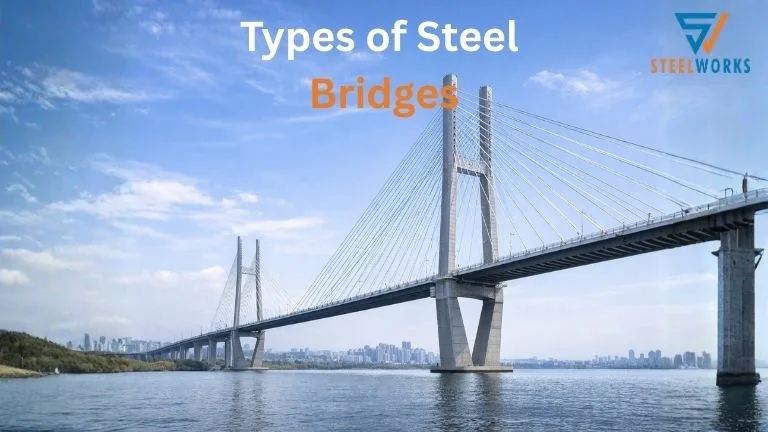
Cable-Stayed Bridges look similar to suspension bridges but work differently. Cables run directly from towers down to the deck. They’re faster to build and often cheaper for medium-long spans while looking pretty dramatic.
Cantilever Bridges stick out from their supports without needing columns underneath. Super useful for crossing deep valleys or rivers where putting supports in the middle would be impossible or mess up the environment.
Advantages of Steel Bridges
Why do engineers keep choosing steel? The advantages of steel bridges stack up pretty convincingly:
Cost makes sense – Steel construction costs compete well with other materials, especially for longer spans. Factor in faster building times saving on project loans, and steel often wins the money argument.
Quality stays consistent – Factory-made components under controlled conditions beat on-site construction for quality. Every weld gets checked before pieces leave the manufacturing plant. No hoping workers do things right in bad weather.
Maintenance stays low – Modern coatings and weathering steel need minimal upkeep over decades. Annual checks and occasional paint touch-ups keep bridges running safely without major renovation projects eating budgets.
Environment benefits – Steel is 100% recyclable. Old bridges don’t become garbage dumps – they become material for new construction. This circular approach just makes sense environmentally.
Load capacity is reliable – Heavy trucks, freight trains, crowds of people – steel bridges handle whatever gets thrown at them. Engineers can calculate exactly what loads the bridge will face and design accordingly.
Adaptation is possible – Existing steel bridges can be strengthened or widened more easily than concrete structures. When traffic grows, steel bridges adapt rather than needing complete replacement.
Steel Components That Build Bridges
Here’s what actually goes into building different types of steel bridges:
Composite Girders mix steel beams with concrete decks. Both materials work together, each doing what it does best. Smart engineering gets maximum value from both.
Steel Truss frameworks are those triangular patterns forming bridge backbones. Trusses spread loads efficiently while using minimal material. Strong and economical at once.
Steel Girders are the main load-bearing beams. They come as I-beams, box sections, or plate girders depending on how long the span is and what loads it needs to carry.
Open Web Girders have web sections with holes, cutting weight while keeping strength. Those openings also let utility lines run through the bridge.
Open Web Steel Girders are specialized versions optimized for specific loading patterns, popular in industrial and commercial bridge work.
Bowstring Girders have curved top sections looking like an archer’s bow. They combine arch and truss concepts for medium spans.
Camel Back Girders feature distinctive humped upper sections. The curve isn’t random – it optimizes material placement for specific spans and loads.
Foot Over Bridges use lighter steel components since they only carry people, not vehicles. These FOBs provide safe urban crossings over railways and highways.
Why Choose Steelworks for Bridge Construction Projects?
When you’re picking a bridge construction partner, Steelworks brings specific strengths:
We handle complete design-build services from initial concepts through final installation. Our engineering team designs bridges from scratch or works with existing plans, ensuring everything meets structural requirements and regulations.
Steelworks specializes in high-traffic roadway bridges moving transportation networks efficiently. Our railway bridges support vital rail connections for passengers and freight. We build pedestrian bridges creating safe urban crossings.
Our fabrication facilities use precision equipment ensuring every component match exact specifications. Quality checks verify structural integrity before anything leaves our factory.
We provide turnkey execution – design, fabrication, transportation, erection, testing. One partner accountable from start to finish. No finger-pointing when issues arise.
Our bridges connect communities across India, from cities to remote areas. They demonstrate engineering excellence through decades of reliable performance.
We continuously adopt advanced steel bridge design techniques, incorporating the latest materials and methods. Our commitment goes beyond meeting specifications – we build bridges communities trust for generations.
READ MORE- Tunnel formwork , PEBs
Building What Connects Us
Understanding types of steel bridges reveals sophisticated engineering behind structures we cross daily without thinking. Each bridge type serves specific purposes, engineered for its environment and usage.
The advantages of steel bridges – strength, speed, durability, recyclability – make them the smart choice for modern infrastructure. As India keeps growing and connecting, steel bridges play crucial roles supporting economic development and improving lives.
Steelworks brings decades of expertise to every project. Whether you need roadway bridges handling heavy traffic, railway bridges supporting freight, or pedestrian bridges creating safe crossings, we deliver solutions that last.
Planning a bridge project? Contact Steelworks for expert consultation on design, manufacturing, and installation. Visit www.steelworks.in to discuss your specific requirements.
FAQs
The main types include beam, truss, arch, suspension, cable-stayed, and cantilever bridges
Steel offers high strength, flexibility, durability, and a strong strength-to-weight ratio, making it suitable for different bridge designs.
Suspension bridges are ideal for very long spans, while cable-stayed bridges are suitable for medium to long spans.
Steel bridges offer high load capacity, faster construction, consistent quality, durability, recyclability, and easier modification or strengthening.
Common components include steel girders, trusses, composite girders, open web girders, bowstring girders, camel back girders, and steel structures for foot over bridges.