Industrial building construction has a cost problem that most project owners discover too late. Conventional construction estimates routinely expand by 15–25% before the structure is complete — material delays, labour overruns, extended site timelines, and design changes that cascade through execution. Industrial cost optimization isn’t just about getting a lower quote upfront. It’s about choosing a construction system where the variables that cause overruns are controlled from the start.
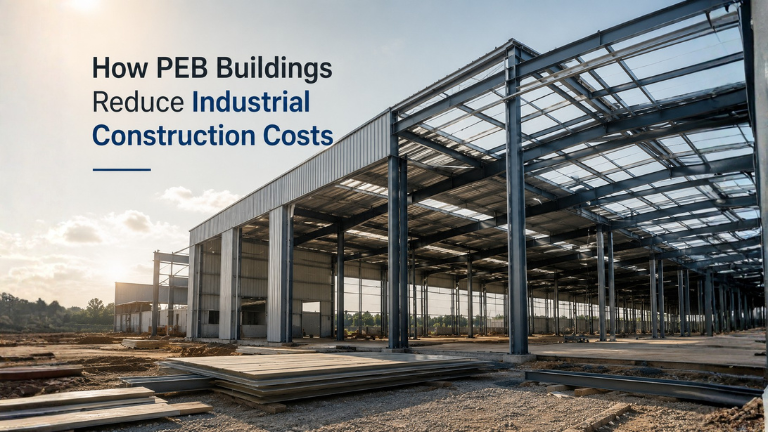
Pre engineered buildings — PEBs — are what modern steel construction systems are built on. The structural components are designed, fabricated off-site, and assembled on location, which compresses timelines and reduces site-level uncertainty significantly. For factory building solutions, warehouse construction, and manufacturing facilities, this approach has become the dominant model for a reason.
Steelworks, based in Gurgaon, has been designing and fabricating PEB structures, steel bridges, and industrial infrastructure for over 40 years — trusted by clients including NHPC, BHEL, Delhi Metro, and CPWD. Their PEB work covers the full scope from design through erection for industrial and commercial projects across India.
What Are PEB Buildings?
Pre-engineered buildings are steel structure buildings designed as a complete system — primary steel frame, secondary structural elements, cladding, and roofing — where everything is engineered together from the start. Unlike conventional construction where components are designed and procured separately, a PEB is a coordinated package.
The key is that fabrication happens in a controlled factory environment rather than on site. Steel building solutions like these have tighter fabrication tolerances, fewer material wastage points, and faster assembly times than anything built from the ground up on a live site.
Why Industrial Cost Optimization Matters
On a conventional industrial construction project, cost pressure comes from several directions simultaneously. Labour is unpredictable. Material procurement takes time and price exposure. Site conditions create delays. Every week a project runs over schedule is a week of carrying costs before the facility is operational.
For a manufacturer building a new production facility, or a logistics company adding warehouse space, that operational delay has a direct financial impact. Industrial construction cost isn’t just the building — it’s the revenue not generated while the building takes longer than planned.
Industrial cost optimization means selecting a construction approach where the schedule is reliable, the material quantities are precise, and the execution risk is as low as it can be made. PEB construction addresses each of those three variables.
How PEB Buildings Help Reduce Construction Costs
Material efficiency is the first saving. Because PEB structures are engineered as integrated systems, steel is specified precisely for the loads the structure will carry — no oversizing, no guesswork. Studies comparing PEB to conventional steel frame buildings typically show 25–35% less steel used for equivalent structural performance.
Reduced foundation cost follows from the lighter structure. Prefabricated industrial buildings weigh less than their conventional equivalents, which means smaller and shallower foundations. On large factory building design projects, foundation savings alone can be significant.
Factory fabrication quality reduces site waste and rework. Components arrive ready to bolt together. There’s no cutting, welding, or fitting on site — activities that generate waste, take time, and introduce human error. The assembly process is closer to installation than construction.
Procurement control eliminates the price exposure of open-market procurement. When Steelworks quotes a PEB project, the steel is specified and often committed at a fixed price at contract stage. For clients who’ve watched material costs move significantly between tender and construction, this predictability has real value.
Faster Construction Means Lower Project Costs
Fast track construction is where PEB delivers its most visible advantage. A conventional factory shed construction or industrial shed project of 10,000 sq ft might take 9 to 12 months from design to handover. A PEB of equivalent area, with design and fabrication overlapping and a short erection window, can achieve the same in 4 to 6 months.
That compression has a cost translation. Shorter construction periods mean less site management time, fewer months of temporary facilities, earlier start to production or operations, and reduced financing carrying costs. For a manufacturing facility construction project with commercial constraints, halving the construction timeline is worth more than the difference in material cost.
Turnkey industrial construction packages — where one contractor handles design, fabrication, supply, and erection — are also less coordination-intensive for the client. Industrial construction planning gets simpler when there’s one accountable party rather than several separate contracts to manage.
Long-Term Cost Benefits of PEB Structures
The cost case doesn’t end at handover. PEB structures carry maintenance advantages over the full life of the building.
Hot-dip galvanised or coated steel doesn’t require the periodic painting and repair cycles that conventional construction often does. Industrial warehouse solutions built with quality cladding systems have longer service lives for roofing and wall panels. Thermal performance is easier to specify in prefabricated systems, which affects air conditioning operating costs in temperature-controlled facilities.
Sustainable industrial buildings are increasingly specified by clients with ESG commitments — steel is fully recyclable, PEB steel content is often partially recycled already, and the precision fabrication process generates less site waste than conventional methods. For commercial steel structures going through green building certification, PEB’s material efficiency supports certification targets.
Structural modifications and expansions are also more straightforward. PEB systems are designed with future expansion in mind — adding a bay or raising an eave height is an engineered process, not a demolition and rebuild.
How to Choose the Right PEB Partner
The PEB market in India has many players at different quality levels. A few things separate reliable partners from lower-cost alternatives that create problems in execution.
Design competency — the right factory building solutions partner should have in-house engineering that can handle loads, local wind and seismic conditions, and column-free span requirements without outsourcing design decisions.
Fabrication quality — certified facilities, quality control at each production stage, and traceable steel procurement. Ask for mill certificates and quality documentation.
Erection experience — a fabricator who also manages erection is more accountable than one who hands over to a third party. Industrial project cost savings disappear quickly if erection problems arise after delivery.
Project references — completed projects of similar scale and application type are the most reliable indicator. Ask for site visits or client contacts.
Steelworks has delivered PEB structures alongside steel bridges and tunnel formwork systems for clients in government, infrastructure, and private industrial sectors. For project enquiries, contact mail@steelworks.in or visit steelworks.in.
Conclusion
PEB construction reduces industrial costs by compressing timelines, controlling material quantities, improving quality through factory fabrication, and lowering long-term maintenance demand. Industrial cost optimization through modern steel construction systems isn’t a compromise — it’s a more engineered approach to the same outcomes.
For industrial and commercial projects where schedule, cost certainty, and long-term performance all matter, the PEB model has a strong and well-documented case.
Yes, PEB buildings are widely used for factories, warehouses, logistics hubs, workshops, and other industrial facilities.
They reduce material wastage, shorten construction timelines, lower labour requirements, and improve overall project efficiency.
Yes, most PEB structures are designed for easy expansion, making them ideal for growing industrial operations.
PEBs offer faster construction, cost savings, design flexibility, and reliable structural performance for industrial facilities.
Yes, quality steel structures typically require less maintenance and offer long-term durability with proper protective coatings.