
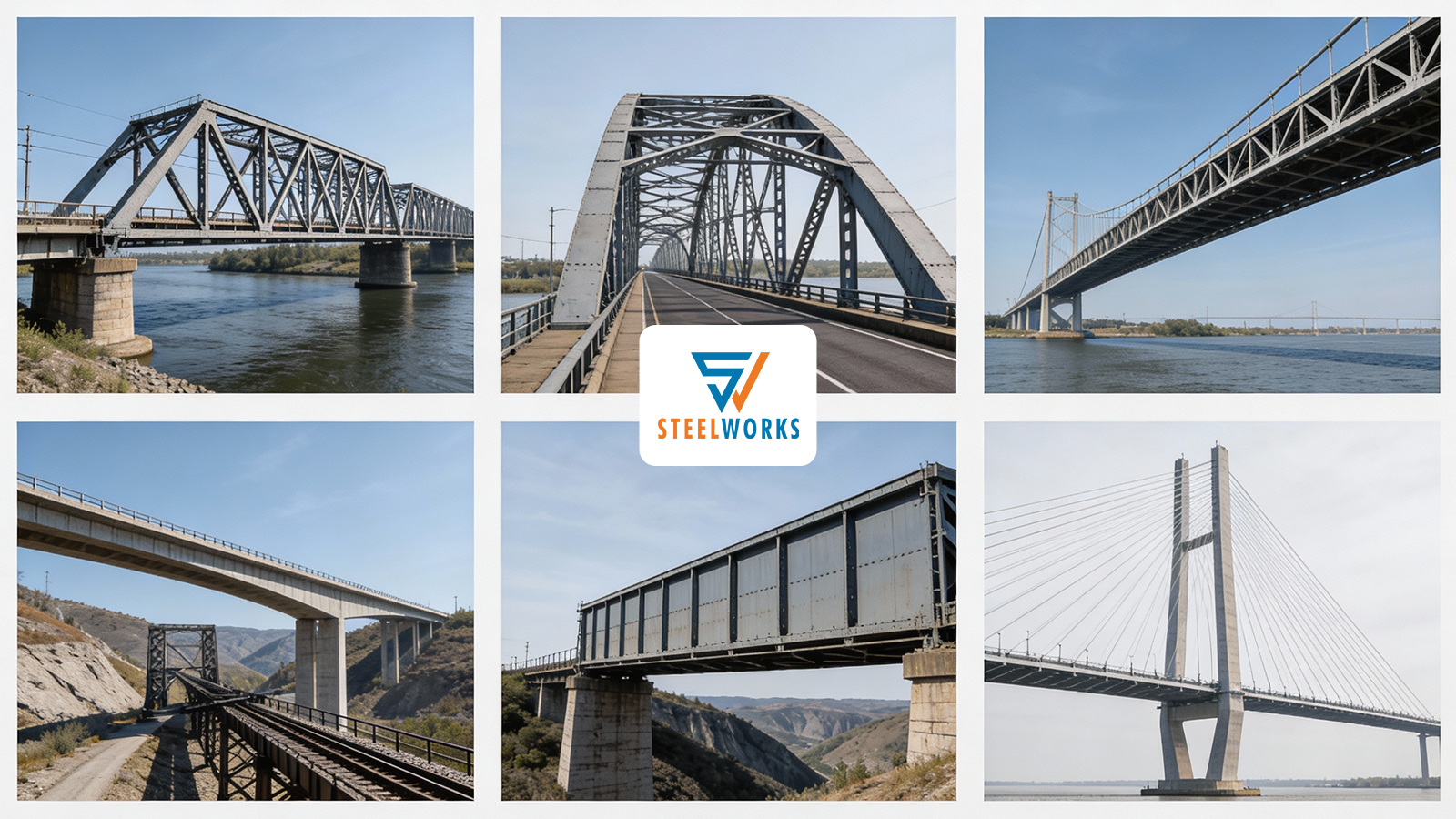
There’s something special about a steel bridge. It’s not just a way to get from one side to the other. It’s a promise of connection. For folks in towns and cities, it means easier commutes and a stronger local economy. For us at Steelworks, a bridge starts as a blueprint—a perfect mix of smart engineering and creative vision. It’s where we figure out how to make something incredibly strong and also look elegant.
So, how do you even begin to design a steel bridge? It starts with a deep understanding of the different types of bridges and the forces they must face. Let’s break down the fascinating world of steel structure bridge design together.
Why Do We Need So Many Different Bridge Designs?
You don’t need a massive, elaborate bridge to cross a small creek, right? The same logic applies everywhere. The final steel bridge design isn’t random; it’s the direct answer to a specific set of challenges.
- The Distance (The Span): This is a huge factor. A short hop might just need simple beams. But for a wide river valley? That calls for an arch or a cable-stayed design.
- The Lay of the Land: Is the ground solid rock or soft soil? Is it a windy spot or an earthquake zone? The land itself tells us a lot about what will work.
- The Bridge’s Job: A bridge carrying a heavy freight train has very different needs than a pedestrian walkway.
- The Budget: Here’s where steel shines. It often goes up faster and lasts longer than other materials, making it a smart financial choice for the long haul.
A Look at Common Steel Bridge Designs
From the everyday to the extraordinary, here’s a quick tour of the most common types you’ll see. Each one is a classic steel bridge design example in its own right.
1. Beam Bridges: The Everyday Workhorse
Picture a standard highway overpass. That’s your classic beam bridge. It uses strong I-beams or plate girders to hold up the deck. For many projects, especially a small steel bridge design, this is the most practical and cost-effective route. It’s simple, strong, and gets the job done.
2. Arch Bridges: Timeless Strength
There’s a reason arch bridges have been around for centuries—they’re brilliant. The curved shape naturally pushes weight outward towards its solid foundations. A modern favorite is the “tied-arch,” where the deck hangs from the arch. It’s a beautiful and efficient piece of steel structure bridge design.
3. Cable-Stayed Bridges: The New Icons
You’ve seen them—bridges with cables streaming straight down from tall towers to the deck. These modern marvels are perfect for medium to long spans. They make a bold statement and are a highly efficient solution for crossing wide spaces.
4. Suspension Bridges: The Long-Haul Giants
These are the record-holders, stretching across vast distances. Think of the Golden Gate Bridge. Huge main cables, strung between towers and anchored at each end, do all the heavy lifting. When the gap is truly massive, a suspension bridge is often the only answer.
Here’s a simple cheat sheet:
| Bridge Type | Best For | Span Range |
| Beam Bridge | Highways, rural roads, small crossings | Short Spans |
| Arch Bridge | City landmarks, scenic river crossings | Medium to Long Spans |
| Cable-Stayed | Major river crossings, modern landmarks | Medium to Long Spans |
| Suspension | The longest crossings over water | Very Long Spans |
What Really Holds a Bridge Up? The Basics of the Design
Underneath all the steel and concrete, a bridge’s design is all about handling “loads.” That’s just an engineer’s word for all the forces the bridge will face in its lifetime.
- The Permanent Stuff (Dead Load): This is the bridge’s own weight—the steel, the concrete deck, the railings, everything that never moves.
- The Moving Parts (Live Load): This is the weight of the traffic. We design for everything from cars and pedestrians to the heaviest trucks and trains. For any small steel bridge design on a road, we test the design against specific, heavy truck models.
- Mother Nature’s Forces: A bridge has to stand up to more than just traffic. Wind, earthquakes, and even the steel expanding on a hot day are all calculated into the steel structure bridge design.
The Bridge’s Knees: Why Bearing Design is a Big Deal
Let’s talk about a component that doesn’t get much glory but is absolutely critical: the bearings. If you follow one piece of advice from any steel bridge bearing design and detailing guidelines, it’s this: don’t overlook them.
Think of bearings as the bridge’s knees. They’re the precise points where the bridge deck rests on its supports. They have two vital jobs: first, to transfer all that weight safely down to the ground, and second, to let the bridge move. A good bearing allows the bridge to flex, expand, and contract with the seasons without cracking or breaking. Getting the steel bridge bearing design and detailing guidelines right is what ensures a bridge can handle decades of use safely.
Building Connections That Last
A successful steel bridge design gives us more than just a safe path over an obstacle. It gives us a structure that is efficient, cost-effective, and often, a thing of beauty. It’s a detailed process that needs a sharp eye from the first sketch to the final bolt, especially for components like the bearings.
Here at Steelworks, we live and breathe this stuff. We take complex blueprints and turn them into real, lasting structures. With our deep knowledge of steel structure bridge design and a hands-on approach to fabrication, we’re the partner you can count on to build solid, reliable connections for your community.
Got a project in mind? Let’s talk. Reach out to Steelworks today and let’s build the future, together.
FAQs
Steel bridge design is the process of planning a bridge to safely handle loads, span requirements, environmental forces, and site conditions.
Common types include beam, arch, cable-stayed, and suspension bridges, with each suited to different spans and applications.
Span length, site conditions, bridge purpose, expected loads, environmental forces, and project budget all influence the final design.
Bridge bearings transfer loads to supports while allowing controlled movement caused by temperature changes and other forces.
Steel provides strength, flexibility, and efficient construction, making it suitable for bridges with different spans, loads, and design requirements.